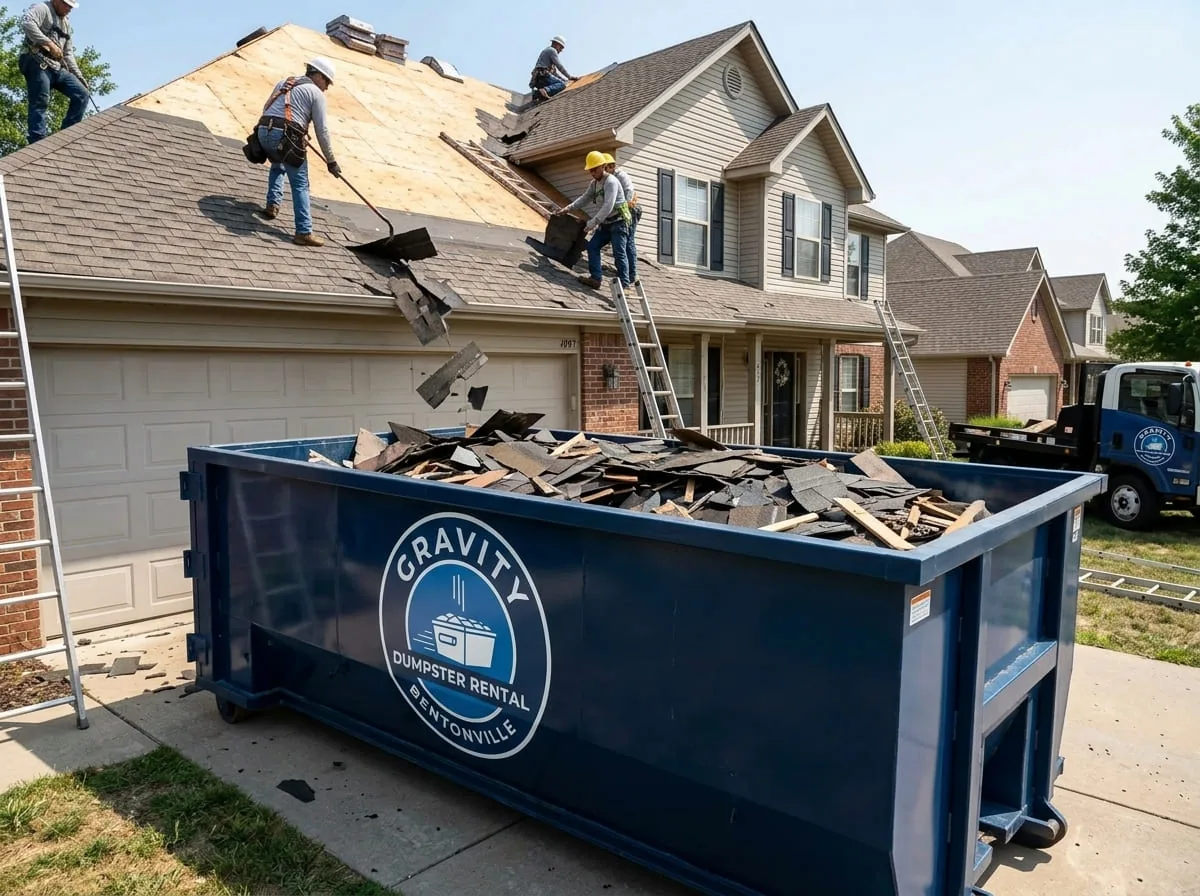
Ask five people in Northwest Arkansas what a dumpster costs and you will get five different answers, and every one can be technically true. A 20-yard box for a garage cleanout and a 20-yard box for a torn-off roof are the same size container from the same yard, yet they can land on very different invoices. The size on the side of the box is only the opening bid. What actually decides the number is a combination of how heavy the debris is, how long the container sits on your property, how far it travels, and whether anything inside it needs special handling.
None of that is a secret, and none of it should be a surprise on pickup day. A straightforward operator can walk you through every factor on the phone before a truck ever leaves our SW Aviation Street yard. This guide breaks down what drives the price up, what brings it down, and how to spot a genuine flat-rate quote versus the low-advertised-price-plus-fees approach some haulers still use.
What Actually Sets the Price
A dumpster rental quote is really five separate variables bundled into one number: the container size, the weight of what goes in it, how many days you keep it, the round-trip distance from the yard, and whether the load includes anything that needs to be handled outside the normal process. Change any one of those and the number moves, even if everything else stays identical. Knowing which lever you control — and which ones your project simply dictates — is the difference between a quote that makes sense and one that feels arbitrary.
Size Is the Starting Point, Not the Whole Story
Bigger containers cost more than smaller ones, and that part is intuitive. Our full size lineup runs from a compact 10-yard dumpster suited to a single-room cleanout or a small deck teardown up to a 40-yard box for a full remodel or new-build cleanup. A mid-range 20-yard dumpster is the workhorse for most kitchen and bathroom remodels, whole-house decluttering jobs, and small additions.
But size answers only one question: how much volume you have to fill. It says nothing about how heavy that volume is, and weight is usually the bigger swing factor. This is where first-time renters get surprised most often, not because anyone hid anything, but because volume and weight are simply not the same measurement.
Weight Versus Volume: Why a Full Box Isn't Always a Heavy Box
Every dumpster rental includes a stated tonnage allowance for its size — for example, a 10-yard container typically includes one to two tons, while a 30-yard container includes three to four tons. Go over that allowance and an overage charge applies for the extra weight. Go under it and you simply paid for the size you needed.
The catch is that different debris hits its weight allowance at wildly different fill levels. Broken concrete, brick, and block run roughly 3,000 to 4,000 pounds per cubic yard, dense enough that a 10-yard box can reach its full one-to-two-ton allowance with well under a foot of material across the floor — nowhere close to a visually full container. Mixed household or construction debris, by contrast, is bulky and light, typically 200 to 400 pounds per cubic yard, so you can fill the same box to the rails without approaching the tonnage limit. Roofing debris sits in between and depends on shingle type: standard three-tab shingles run roughly 230 to 250 pounds per square (100 square feet of roof), while architectural or laminated shingles run notably heavier at roughly 350 to 430 pounds per square. A roof tear-off that looks identical from the ground can load very differently depending on which shingle type is coming off, which is why our roofing dumpster rental guidance always asks about shingle layers before recommending a size.
This is also why concrete, brick, and other heavy debris almost always calls for a smaller container than the volume alone would suggest — a bigger box does not buy more concrete capacity, it just costs more for space you cannot use before the weight limit catches up with you.
Rental Length and Distance From Our Yard
A flat-rate quote is built around a stated rental period, commonly measured in days, covering delivery, the time the container sits on your property, and pickup. Projects that wrap up early rarely get a refund for unused days, but projects that run long typically incur a per-day extension charge once the included period ends. If you know a project will stretch — a DIY renovation done on weekends, or a cleanout that depends on family flying in — say so on the call, since booking an accurate window up front beats negotiating an extension later.
Distance matters too. Every delivery starts at our yard near Louise M. Thaden Field in southwest Bentonville and ends at a disposal facility, then reverses for pickup. Properties close to that route cost less to serve than ones on the far edges of the service area, simply because more drive time means more fuel and more of a driver's day committed to one job. That is one reason a quote for a job in Bentonville proper can differ from a quote for the same size box delivered to Centerton or a rural stretch of Benton County — it reflects miles, not a different rate for the same service.
Loads That Need Special Handling
Most residential and construction debris loads straight into a container with no extra steps. A short list of items change that: mattresses and box springs, tires, appliances containing refrigerants, electronics, and anything flagged as hazardous typically require separate handling or disposal, and some may not be allowed in a standard container at all. This is not arbitrary red tape — several of these categories are regulated separately from ordinary solid waste. Our junk removal service is often the better fit than a dumpster rental when a load is mostly individual items like these rather than bulk construction or renovation debris. Before you book, it is worth a quick read through what can and cannot go in a dumpster in Arkansas so nothing on load day catches you off guard.
A Genuine Flat-Rate Quote Versus the Low-Price-Plus-Fees Trap
A legitimate flat-rate quote is one number that already includes delivery, the agreed rental period, pickup, disposal, and a clearly stated tonnage allowance for the container size. You know before the truck arrives roughly what you are paying and what you get for it. The alternative — an advertised price that looks unusually low, followed by separate delivery fees, separate pickup fees, an environmental fee, a fuel surcharge, and a razor-thin weight allowance that almost guarantees an overage charge — is how a cheap-looking quote turns into an expensive one after the fact.
The table below breaks down what typically pushes a quote up and what keeps it down, without attaching invented numbers to either side.
Questions to Ask Before You Book
A few questions on the phone will tell you almost everything you need to know about whether a quote is genuinely flat-rate:
- Does the quoted number include delivery and pickup, or are those billed separately?
- What is the tonnage allowance included for this size, and what does going over it cost per ton?
- How many days does the rental period cover, and what happens if I need it longer?
- Is there a separate fuel, environmental, or disposal fee on top of the quoted price?
- Does the price change if the debris turns out heavier than expected, and how would that be verified?
If a hauler cannot answer these clearly and immediately, treat that as useful information in itself. For construction jobs specifically, it is also worth checking whether your city requires a placement permit — our city-by-city permit guide covers that separately, since it is a municipal question rather than a pricing one.
How NWA's Growth Boom Shapes Scheduling and Pricing
Northwest Arkansas is not a static market, and that affects more than real estate listings. With Walmart headquartered in Bentonville and Tyson Foods and J.B. Hunt anchoring the broader corridor, the region has seen sustained population growth and a steady wave of new-construction subdivisions around Bentonville, Centerton, and Bella Vista. That growth feeds dumpster demand directly: during peak building seasons, container availability tightens and lead times stretch, especially for the larger sizes construction crews rely on. It rarely changes the structure of a flat-rate quote, but it is a real reason to book early once you have a project date, particularly for a job tied to a new-construction timeline where the container needs to show up on schedule. Sites doing footer or utility work alongside the cleanup should also remember that Arkansas law requires calling Arkansas 811 before any digging, regardless of when the dumpster itself arrives.
How Overage Charges Happen — and How to Avoid Them
Almost every overage charge traces back to one of two things: an inaccurate description of the debris on the booking call, or a container filled above its rails. Both are avoidable. When you call to book, describe the job honestly — if there is old concrete under that deck, or a layer of shingles you are not certain about, say so. A hauler who knows what is actually coming can recommend the right size the first time, which is cheaper than guessing small and paying an overage, or guessing large and paying for capacity you never use.
The rail rule matters just as much. Debris mounded above the top edge of the container is not just against most haulers' policy, it is often against state transport regulations, since an uncovered, overloaded load is a road hazard. Keeping material level with or below the rails, breaking down bulky items so they pack flatter, and checking our size guide against your actual debris volume before you book are the three habits that prevent almost every surprise overage fee. Licensed haulers operating in the region are required to register with the Benton County Solid Waste District, and solid waste disposal itself is regulated at the state level by the Division of Environmental Quality within the Arkansas Department of Energy and Environment — both are worth knowing about if you ever want to confirm a hauler is operating legitimately.
Getting an Honest Number for Your Project
The most reliable way to get an accurate price is still the most old-fashioned one: describe the project on the phone, get a straight answer on size, tonnage allowance, and rental period, and confirm delivery, pickup, and disposal are already built into that number. In eleven years of doing this out of our yard on SW Aviation Street, the jobs that go smoothest are the ones where the debris description matched what actually showed up on load day. Call (479) 364-6780 and we will walk through your project, recommend the right size from our lineup, and give you one flat number before anything is scheduled.