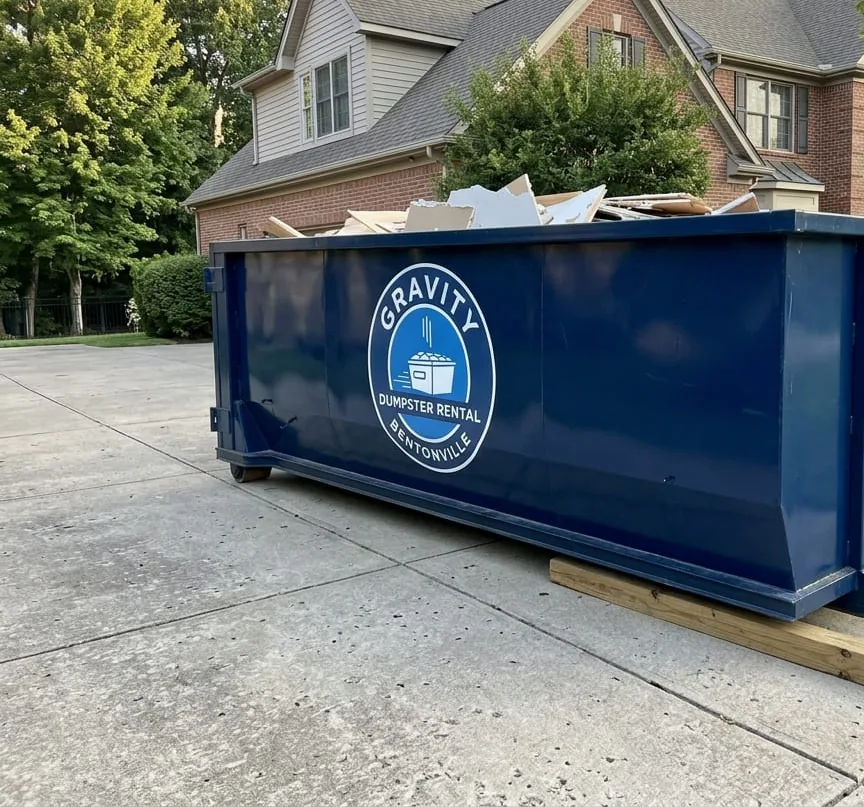
Renting a roll-off dumpster is easy. Knowing where you're allowed to put it once it arrives is the part people skip until a code enforcement officer or a city truck driver points it out. The short version: if the container sits entirely on your own driveway, yard, or lot, almost every city in Northwest Arkansas leaves you alone. The moment any part of it touches the street, the curb, or the strip of grass between the sidewalk and the road, you've crossed into public right-of-way, and that's where permit rules, insurance requirements, and reflective markers start showing up in city code.
We pulled what each city in our service area actually publishes on this, city by city, rather than repeating the generic "check local regulations" line every dumpster site uses. A couple of cities spell it out in some detail. Most don't publish anything specific, and we say so plainly below instead of guessing. Bentonville, Rogers, Centerton, Springdale, Fayetteville, Pea Ridge, and Gravette are true municipalities with their own ordinances. Bella Vista is not — it's run in part by a private property owners association, and that distinction matters for anyone renting a dumpster there.
The General Rule: Driveway vs. Street
Across nearly every city, the placement question comes down to who owns the ground underneath the container. Your driveway, garage pad, side yard, or any part of your lot is private property, and cities generally don't regulate what you set on it temporarily, dumpster included, outside of normal property-maintenance rules about blight or standing debris. The street, the curb lane, and the shoulder are public right-of-way, owned and maintained by the city (or the county, outside city limits), and putting anything there — a dumpster, a construction trailer, a stack of lumber — is technically an obstruction unless the city has given permission.
That permission usually comes as a right-of-way permit, sometimes bundled with a building permit for active construction projects, sometimes issued separately by a public works or engineering department. Requirements vary widely: some cities want a certificate of insurance from the dumpster company, some require reflective tape or cones around the container overnight, some cap how many days it can sit at the curb, and some simply haven't published a rule because it hasn't come up often enough to write one. Worth noting: this is strictly a municipal, street-level question. It's separate from state solid-waste regulation, which in Arkansas is handled by the Arkansas Department of Energy and Environment's Office of Land Resources and covers things like landfill permitting, not where a container sits on a residential street.
Northwest Arkansas is growing fast enough that placement is a live issue in practice. New subdivisions, teardown-and-rebuild lots, and infill construction all generate driveways that are gravel, mud, or nonexistent on the day a dumpster needs to show up, which pushes more containers toward the curb than you'd see in a slower-growing area.
Bentonville
Bentonville is the one city in this list with a clearly published, general-purpose right-of-way permitting process. The city's Right-of-Way Permit program covers work and placements within city streets and easements, with its own application and a filing fee. The published application doesn't spell out "dumpster" line by line — it's written broadly enough to cover utility work, driveway aprons, and other obstructions — so the safest move if you need curb placement in Bentonville is to call Public Works directly and confirm a roll-off container falls under that permit before the truck shows up. Private-property placement, on a driveway or yard you control, doesn't require this permit at all; it only applies once the box is sitting in the street or the right-of-way strip.
Rogers
Rogers doesn't publish a dedicated dumpster or roll-off ordinance that we could locate. The city's Code Enforcement and Neighborhood Services division handles the property-maintenance side — debris accumulation, tall grass, inoperable vehicles — but nothing specific to temporary roll-off containers on a driveway. Public Works maintains a Right-of-Way Division that handles street-related permitting generally, which tells you the mechanism exists, but we found no published rule spelling out dumpster placement specifically. Treat this as no rule specifically published — check with the city before setting a container in the street in Rogers. Driveway placement is a non-issue either way.
Bella Vista Is Different: It's a POA, Not a Standard City
This is worth slowing down for, because it trips people up. The City of Bella Vista handles the things you'd expect from any municipality — police and fire protection, street maintenance, trash collection, and building and code enforcement. But a large share of what makes Bella Vista feel like Bella Vista — the golf courses, lakes, parks, trails, recreation centers, and pools — is owned and run by the Bella Vista Property Owners Association, a private membership organization, not a government body. On top of that, an Architectural Control Committee reviews exterior changes and new construction against the neighborhood's protective covenants.
What that means for a dumpster rental: street and right-of-way placement is a City of Bella Vista matter, since the city (not the POA) maintains the streets. We did not find a published city rule specific to dumpster placement in the right-of-way, so treat that as unconfirmed and call the city to check before curb placement. Private-property placement — your own driveway — generally isn't something the city regulates day to day, but if you're doing a renovation or new build in a POA-covered subdivision, it's worth a quick check of your property's covenants or a call to the POA's Member Resources line, since some Bella Vista neighborhoods have architectural or property-appearance rules that go beyond what a standard city ordinance would ever touch. That's on top of, not instead of, any city permit question. Our Bella Vista service page has more on scheduling delivery in the area.
Centerton and the New-Subdivision HOA Factor
Centerton's zoning code addresses dumpster enclosures for commercial properties — screening requirements for permanent trash and recycling areas — but we did not find a published rule governing temporary roll-off placement on a residential driveway or in the street. That's a "not published — confirm with city" situation, and given how fast Centerton has grown in the last decade, it's genuinely worth a phone call rather than an assumption, since street and permitting rules in fast-growing cities get updated more often than the website catches up with.
The more practical issue in Centerton, and in the newer sections of Bentonville and Bella Vista, is the HOA, not the city. A big share of new construction in this corridor goes up inside platted subdivisions with a homeowners association and its own covenants, and those covenants can restrict things a city ordinance never mentions: how long a dumpster can sit visible from the street, whether it has to be screened, or which side of the driveway it can occupy. An HOA can't override city or state law, but it can impose stricter rules on its own members, and violating one can mean a fine even inside city code. If you're renting for a home in a subdivision with an active HOA, a quick look at the covenants is worth five minutes, on top of whatever the city does or doesn't require. See our Centerton page for local delivery details.
Springdale and Fayetteville
Springdale's city site covers its own municipal Bulky Waste Program — the city's scheduled pickup service for large household items — but that's a different thing entirely from a rented roll-off container, and we did not find a published permit rule covering private dumpster placement in the street. Treat right-of-way placement in Springdale as unconfirmed and check with the city before setting a container at the curb; driveway placement isn't something the city regulates.
Fayetteville is the one city in the region whose website suggests it treats this more formally than its neighbors. The city publishes both a "Roll-Off Program" page and a separate "Building Permit – Container and Pad" page, which points to Fayetteville having some structured process around containers and pads tied to active construction. We weren't able to confirm the exact requirements text for either page, so we're not going to guess at fees or specifics here — if you're placing a dumpster anywhere near the street on a Fayetteville project, call the city's Development Services division before delivery day and ask directly whether your situation needs a permit. Driveway-only placement is far less likely to trigger any of this.
Pea Ridge and Gravette
Both of these smaller Benton County cities publish general municipal codes covering streets and sidewalks, but neither has a dedicated, easy-to-find ordinance addressing roll-off dumpster placement specifically. In Pea Ridge, the streets and sidewalks title likely covers general obstructions, but we found no dumpster-specific provision — no rule specifically published, so check with the city before curb placement. In Gravette, the city runs its own municipal bulk-item dumpster program for residents at a set price per load, which is a separate thing from a rented roll-off from a private company; we found no published right-of-way rule for the latter, so confirm with the city before setting a rental container in the street. Driveway placement in either city isn't something we found regulated.
Private Property vs. Right-of-Way, City by City
New Construction and a Fast-Growing Region
Benton and Washington counties are two of the fastest-growing counties in the country, driven largely by the corporate corridor anchored by Walmart, Tyson Foods, and J.B. Hunt. That growth shows up as a constant supply of new subdivisions, teardown-and-rebuild lots, and infill projects, and it means right-of-way rules in this region are more likely to be revisited by city councils than in a place where the road network hasn't changed in decades. A rule that wasn't on the books two years ago can exist today, and a city that never enforced curb placement in a quiet neighborhood might enforce it strictly near active new development.
New-construction sites are the most common reason a dumpster ends up in the street in the first place, since the driveway itself often doesn't exist yet — it's graded dirt, a gravel pad, or simply not poured. If you're working a lot without a finished driveway, plan the container's spot before delivery day, and ask directly whether the site plan or building permit already addresses container placement. Our new-construction dumpster guide and placement and driveway protection guide go into more detail on planning around an unfinished site.
What to Do When You're Not Sure
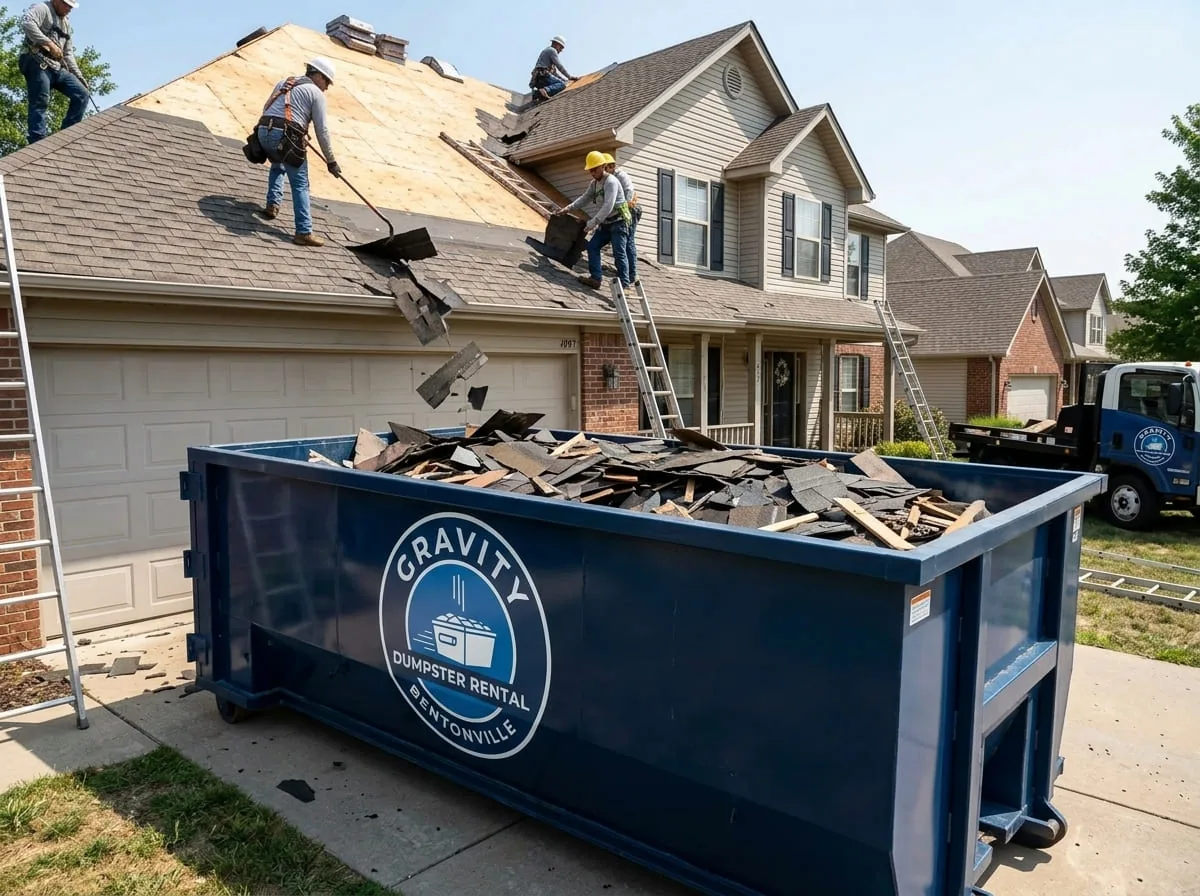
None of this is meant to make renting a dumpster sound complicated. In the overwhelming majority of jobs — a driveway cleanout, a roofing tear-off, a kitchen remodel — the container sits entirely on your own property and no city has any say in it at all. Permits only enter the picture when there's no room on the lot and the box has to sit at the curb, which is common enough on tight in-town lots and active construction sites that it's worth asking about before you book rather than after a container is already sitting in the street.
When you call us to schedule a roll-off dumpster rental or a construction dumpster for a job anywhere in Northwest Arkansas, tell us up front if the driveway is tight, unfinished, or nonexistent, and we'll talk through whether the spot you have in mind is a private-property placement or a right-of-way question worth a call to the city first. We deliver across the full service area, and we'd rather help you get the permit question answered before delivery day than have a container sit somewhere it shouldn't. Call (479) 364-6780 or reach out through our contact page and we'll help you sort out where your dumpster can legally go before we ever load the truck.